


Table of Contents
- What Mortgage Lead Generation Tools for Brokers Must Do in 2026
- Mortgage Lead Generation Strategies That Actually Convert
- How to Generate Free Mortgage Leads Without Paid Ads
- Mortgage CRM for Lead Management: Integration and Automation
- Mortgage Lead Conversion Tips: From First Touch to Closed Loan
- Compliance, TCPA, and Lead Quality Verification
- Conclusion
- Frequently Asked Questions
Last Updated: September 12, 2026
What Mortgage Lead Generation Tools for Brokers Must Do in 2026
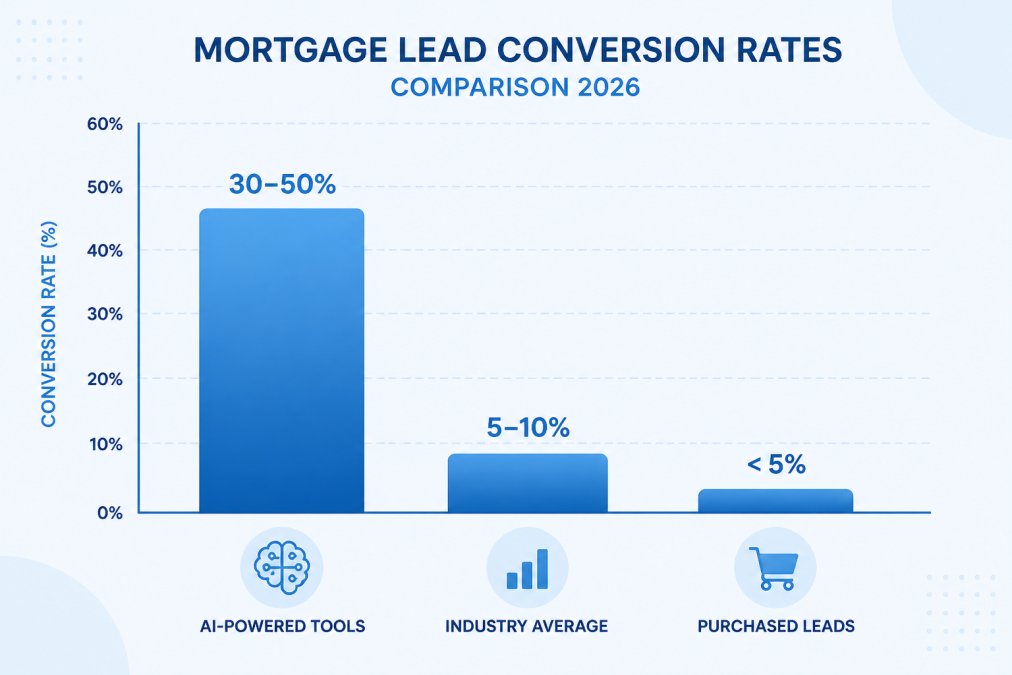
According to LeadPops’ analysis of 3.2 million mortgage leads, AI-powered conversion tools now achieve 30-50% conversion rates, roughly 5-10x the industry average. That gap explains why mortgage lead generation has become the central battleground for brokers this year. This guide from LoanSites breaks down the tools, strategies, and compliance requirements that separate a working pipeline from an expensive distraction.
Here’s the uncomfortable truth most guides avoid: buying leads is dying. The brokers winning in 2026 built proprietary funnels, referral networks, and automated capture systems instead.
The 2026 Shift: Why Buying Leads Is Failing
Purchased leads convert poorly because everyone in the market receives the same contact. LeadGenJay’s 2026 report on lead generation strategy found that brokers who shifted from buying leads to generating their own prospects now convert at 40% or higher. That is not a marginal improvement. It is a different business model.
The tooling has to support organic acquisition, not just distribute purchased contacts.
Core Features That Separate Winning Tools from Expensive Distractions
A mortgage lead generation system worth paying for does four things: captures prospects on your own landing pages, qualifies them automatically, routes them into a CRM without manual entry, and tracks performance by source.
Anything that does not do all four is a partial solution. Tool overload is a real problem too. Brokers running five disconnected platforms lose leads in the gaps between them, a recurring complaint among working loan officers.
| Requirement | What It Looks Like | Why It Matters |
|---|---|---|
| Automated capture | Forms, chat, landing pages feeding one inbox | No lead sits unanswered |
| Qualification | Screening questions, intent signals | Higher conversion per contact |
| CRM sync | Two-way data flow | No manual pipeline pulls |
| Source tracking | Cost-per-lead and CPA reporting | You know what to scale |
Running separate tools for landing pages, chat, and CRM is the most common cause of lost leads. Every handoff between platforms is a place where a prospect goes cold.
Mortgage Lead Generation Strategies That Actually Convert
Effective mortgage lead generation strategies in 2026 share one trait: they own the first touch. Brokers who control the landing page, the follow-up sequence, and the CRM record convert far better than those renting attention from a lead vendor.
Landing Pages and Funnels: Your Highest-Converting Asset
A dedicated landing page with a single call to action outperforms a homepage every time. The reason is simple: a homepage asks visitors to choose. A landing page asks them to act.
Build one page per audience segment. Purchase-focused buyers, refinance candidates, and first-time buyers need different language, different proof, and different offers. A funnel that speaks to all three speaks to none.
The Salesforce mortgage lead generation overview notes that combining local SEO with a strong referral network remains the most durable approach, and landing pages are where that traffic has to land.
Referral Networks and Local SEO: The Compound Growth Play
Referral networks and local search compound in a way paid ads never do. A realtor who sends you three buyers this quarter sends more next year if you close well and communicate consistently.
Local SEO works the same way. A page ranking for “refinance mortgage” in your metro area keeps producing leads without a per-click cost. That is why top brokers are reallocating budget away from purchased leads and into owned digital presence.
How to Generate Free Mortgage Leads Without Paid Ads
Free mortgage leads come from three sources: organic search, referrals, and educational content. None require ad spend. All require consistency.
The most effective approach combines local SEO with a referral network rather than automated lead purchasing, according to Salesforce’s 2026 industry analysis. Here is what that looks like in practice:
- Publish rate and payment explainers that answer real borrower questions
- Claim and complete your local business listings
- Ask every closed client for one introduction
- Build a simple referral tracker so follow-up does not slip
One documented case from The Loan Officer Podcast showed a broker generating 170 leads per month through an AI-driven online setup with no paid ads or introducer network. The mechanism was not magic. It was a funnel that captured, qualified, and followed up automatically.
Mortgage CRM for Lead Management: Integration and Automation
A mortgage CRM for lead management is only as good as its connections. The CRM itself stores contacts. The value comes from what feeds it and what it feeds.
Automated capture sends leads in. Lead nurturing sequences keep them warm. Reporting tells you which sources produce closed loans. When any link is manual, the system degrades.
What a Working Lead-to-LOS Pipeline Actually Looks Like
Most guides stop at “integrate your CRM with your LOS.” That advice is useless without knowing what data has to move and in which direction. A functioning pipeline passes specific fields at specific stages:
| Stage | Data Moving | Direction | Common Failure |
|---|---|---|---|
| Lead capture | Name, contact, loan purpose, consent timestamp | Lead source → CRM | Consent flag dropped, creating TCPA exposure |
| Qualification | Credit band, income range, property type, timeline | CRM → LOS (pre-application) | Field mismatch forces manual re-entry |
| Application | Full 1003 data, disclosures, documents | CRM ↔ LOS (two-way) | One-way sync means status updates never reach the CRM |
| Milestone updates | Appraisal ordered, underwriting, conditional approval | LOS → CRM | No webhook, so the loan officer learns status by logging in |
| Closed loan | Funded date, commission, source attribution | LOS → CRM → reporting | Attribution lost, so CPA by source is wrong |
If any row in that table is handled by a person copying and pasting, you have found the leak. A common pattern among brokers running five or more disconnected platforms is that the average lead sits untouched for hours while someone reconciles records between systems.
Questions to Ask Before You Commit
Vendor demos show the happy path. Brokers need to probe the edges:
- Does the integration use a native API, a middleware connector like Zapier, or a scheduled CSV export? Native APIs sync in near real time; CSV exports run on a timer and can be hours stale.
- Which fields map automatically, and which require custom mapping? Ask to see the field-mapping screen, not a slide.
- What happens when a lead is updated in the LOS but not the CRM? Two-way sync is the standard worth demanding.
- How are duplicate records merged? A borrower who inquires twice through different funnels should not become two pipeline entries.
- What is the fallback when the API call fails? Silent failures are the worst kind.
Test LOS integration before you commit to any platform. Ask for a live demonstration with your actual LOS, not a generic sandbox. Integration gaps rarely show up until real loan files move through the system.
Why Custom Beats Templated on Integration
Off-the-shelf website and CRM bundles typically support a fixed set of integrations. When your LOS is not on that list, you are told to use a middleware workaround that adds cost and latency. A custom-built website and lead system can be architected around your actual LOS from day one, with field mapping designed for how your team already works rather than how a template assumes you work. That is the difference between a system that reduces manual entry and one that just moves it to a different screen. Streamlining these data pathways ensures that your digital infrastructure remains focused on improving website conversions rather than compensating for technical friction.
Mortgage Lead Conversion Tips: From First Touch to Closed Loan
Speed and follow-up discipline drive mortgage lead conversion more than any script. The data supports this clearly: AI-powered tools hit 30-50% conversion while purchased leads often fall below 5%.
A few practices consistently move the number:
- Respond within five minutes; contact rates drop sharply after that
- Use AI live chat to engage after-hours visitors immediately
- Segment follow-up by loan purpose, not by date received
- Track cost-per-acquisition by source, not just total lead volume
Lead quality verification matters here too. A verified contact with confirmed intent is worth more than ten unverified records, and treating them as equivalent distorts your CPA math.
Compliance, TCPA, and Lead Quality Verification
TCPA and DNC compliance is not optional, and it is where many brokers get exposed. Penalties under the Telephone Consumer Protection Act are assessed per violation, not per campaign, which means a single purchased list with bad consent records can generate liability that dwarfs any marketing budget. The compliance burden falls on the broker making the call, not the vendor who sold the list.
What a Defensible Consent Trail Looks Like
Every lead you contact needs a documented consent trail. If you cannot prove how a prospect opted in, assume you cannot legally call them. A defensible record typically includes:
- The exact consent language the prospect saw, captured at the moment of opt-in
- A timestamp and the IP address or source URL where consent was given
- The specific entity the prospect consented to hear from, consent given to a lead vendor does not automatically transfer to you
- A clear record of any opt-out request and the date it was honored
- Retention of these records for the full statute-of-limitations period, which practitioners generally treat as at least four years
Every lead you contact needs a documented consent trail. If you cannot prove how a prospect opted in, assume you cannot legally call them.
Vetting Lead Providers Before You Buy
Recycled and junk leads are both a quality problem and a compliance problem. A short checklist before signing with any provider:
- Ask for the source of consent and the specific opt-in language. If the vendor cannot produce it, walk away.
- Request a sample of 50 records and scrub them against the DNC registry yourself before calling.
- Ask how many times each lead has been sold. Leads sold to five brokers are not exclusive, regardless of what the contract says.
- Confirm whether the vendor scrubs against the DNC on your behalf and whether that scrub is documented.
- Check whether the vendor carries errors-and-omissions coverage and what it actually covers.
A verified contact with confirmed intent is worth more than ten unverified records, and treating them as equivalent distorts your CPA math.
Where Automation Creates Risk
Automated lead capture tools introduce compliance questions that manual processes do not. Chat widgets, AI voice agents, and automated SMS follow-up all trigger TCPA considerations. Two rules of thumb:
- Automated texts and calls require prior express written consent, which is a higher bar than the consent needed for a live call.
- An AI voice agent that uses a prerecorded or artificial voice is treated as an automated telephone dialing system for TCPA purposes.
Brokers deploying these tools should confirm that consent language on their forms explicitly covers automated contact methods, not just “we may contact you.”
Accessibility as a Compliance Layer
Accessibility matters for the same reason. An ADA-compliant website reduces legal exposure while making your funnel usable for every borrower. Web accessibility claims have become a common source of demand letters against financial services sites, and a site built to WCAG standards from the start avoids the retrofit cost later. Custom-built sites can be architected for accessibility from the first line of code rather than patched after a complaint arrives.
Conclusion
The brokers pulling ahead in 2026 are not the ones buying the most leads. They are the ones owning the funnel, automating the follow-up, and keeping the compliance trail clean.
That is the problem LoanSites solves for mortgage professionals. We build custom, high-converting, ADA-compliant websites with unlimited support and unlimited customization, paired with AI live chat, CRM integration, and advanced SEO packages designed to drive traffic and nurture borrower relationships. LoanSites has helped hundreds of the nation’s top loan officers establish authority and close more loans.
Schedule a call with LoanSites and get a website built to generate leads, not just sit there.
Frequently Asked Questions
What are the most effective mortgage lead generation tools for brokers?
The most effective tools combine AI-powered conversion optimization with CRM integration and automated lead capture. Research analyzing 3.2 million mortgage leads shows AI-powered tools achieve 30-50% conversion rates, which is 5-10x the industry average. Look for platforms offering landing page builders, AI live chat, and seamless CRM connectivity. The key is choosing tools that integrate with your existing workflow rather than adding disconnected systems that create data silos and lost leads.
How do I generate high-quality mortgage leads consistently?
Consistency comes from building systems, not chasing tactics. Top brokers generating 40%+ conversion rates focus on proprietary landing pages, local SEO, and referral networks rather than purchased leads. Build a lead generation system that captures prospects through multiple channels, qualifies them automatically, and nurtures them through a structured follow-up sequence.
Is buying mortgage leads worth it for independent brokers?
For most independent brokers, buying leads delivers diminishing returns. The 2026 trend shows top performers shifting away from purchased leads toward organic strategies achieving 40%+ conversion rates. Purchased leads often lack exclusivity, meaning you compete with multiple brokers for the same prospect. Building your own lead generation system through SEO, content marketing, and referral networks creates exclusive leads that convert better and cost less over time.
What features should I look for in mortgage lead generation software?
Prioritize tools with native CRM integration, landing page builders, AI chat capabilities, and ADA-compliant website templates. The software should automate lead capture, scoring, and nurturing without requiring manual intervention at every step. Check for LOS integration to avoid duplicate data entry. Also verify compliance features for TCPA and DNC regulations. The goal is reducing your tech stack, not adding another disconnected tool that creates operational inefficiency.


