


Table of Contents
- Why a Mortgage Website Strategy Call Beats a Generic Contact Form
- Mortgage Website Call to Action Examples That Drive Bookings
- Mortgage Website Conversion Tools That Reduce Booking Friction
- How Long Should a Mortgage Discovery Call Be?
- Mortgage Strategy Call Script: What to Say Before and After Booking
- What to Look for in a Mortgage Website Partner
- Frequently Asked Questions
Last Updated: September 14, 2026
Why a Mortgage Website Strategy Call Beats a Generic Contact Form
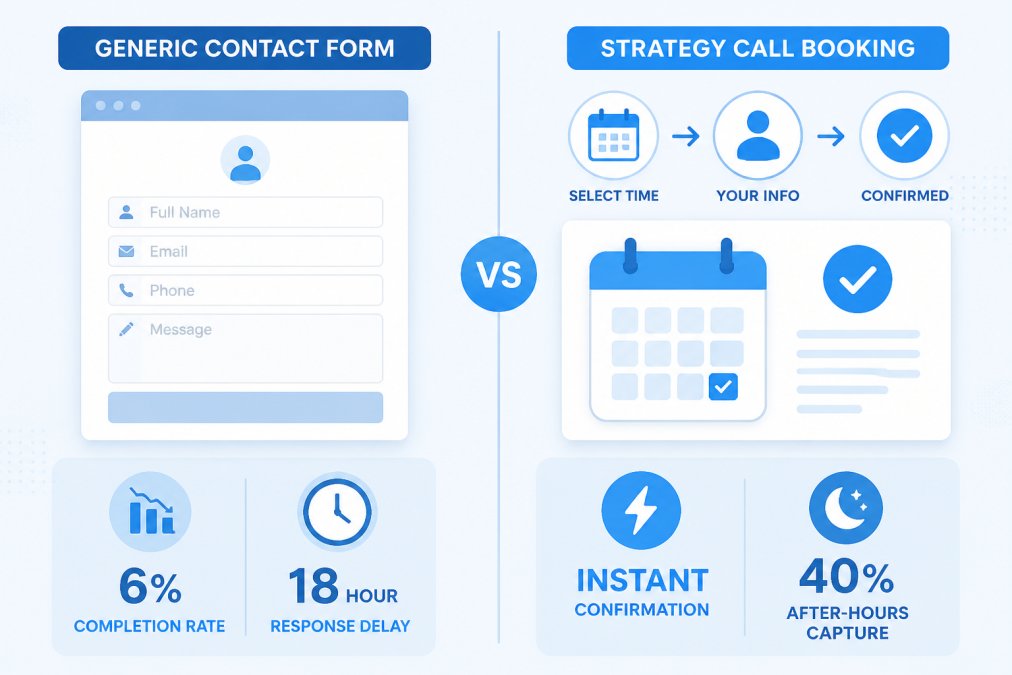
A “Contact Us” form asks a borrower to do your admin work. A strategy call offers expertise instead, and that shift changes who raises their hand. According to leadPops’ mortgage lead generation research, which analyzed 3.2 million mortgage leads, the way you capture a lead shapes whether it ever converts at all. This guide from LoanSites breaks down how to book a mortgage website strategy call that turns anonymous traffic into scheduled conversations.
Mortgage website strategy is the practice of designing every page, form, and follow-up around one measurable action: getting a qualified borrower onto a calendar with a loan officer. A generic contact form collects a name and stalls. A booking path qualifies, schedules, and confirms automatically.
The timing problem makes this urgent. Sayvo’s 2026 speed-to-lead benchmarks show over 40% of web leads arrive outside standard business hours. A form submission at 9:40 p.m. sits until someone checks it the next morning. A booking tool captures that borrower immediately.
The Psychology Behind Booking a Strategy Call
Borrowers book calls when the offer feels like advice, not a sales trap. The word “strategy” does the heavy lifting: it signals a conversation about their situation, not a pitch for your rate sheet.
Three psychological levers drive bookings:
- Low commitment framing. A 15-minute call feels reversible. “Talk to a loan officer” feels like entering a pipeline.
- Specificity builds trust. “Review your refinance options” outperforms “Get in touch” because it names the outcome.
- Reciprocity. Offering a rate review or affordability check gives the borrower something before they give you anything.
The mistake most loan officers make is labeling the button “Free Consultation.” That phrase has been worn flat by every industry. Name the actual deliverable instead.
Mortgage Website Call to Action Examples That Drive Bookings
Strong mortgage website call to action examples share one trait: they name the outcome and remove the ambiguity. Vague buttons get ignored. Specific ones get clicked.
Here are patterns that work, with the psychology behind each:
| CTA Copy | Why It Works | Best Placement |
|---|---|---|
| “Book Your 15-Minute Strategy Call” | Names duration and format | Hero section |
| “See What You Qualify For” | Outcome-focused, low pressure | Rate calculator page |
| “Get My Rate Review” | Possessive language, specific deliverable | Refinance landing page |
| “Schedule a Call With [Name]” | Humanizes, builds accountability | About page |
| “Check My Payment Options” | Curiosity plus practicality | First-time buyer page |
Notice none of them say “Submit” or “Contact Us.” Those words describe what the borrower does for you. Every example above describes what the borrower gets.
Test your CTA copy against the “so what” test. If a borrower reads the button and can’t answer “what happens next,” rewrite it. Buttons that state the next step convert better than buttons that state the action.
Mortgage Website Conversion Tools That Reduce Booking Friction
Friction is any step between intent and a confirmed appointment. Mortgage website conversion tools exist to delete those steps. The fewer clicks between “I’m interested” and “it’s on my calendar,” the more bookings you keep.
The highest-impact tools address the three friction points that kill most bookings:
- Calendar embedding. Let borrowers pick a slot without leaving your site or waiting for an email reply. A native embed that reads your live availability prevents the double-booking and “let me check my calendar and get back to you” loop that loses leads.
- AI live chat. Captures after-hours visitors and books them while intent is hot. The key mechanism is intent detection: a chat that asks “Are you looking to buy or refinance?” routes the borrower to the right calendar before they cool off.
- CRM integration. Pushes booking data straight into your pipeline so no lead goes cold in an inbox. Two-way sync matters more than one-way, if a borrower reschedules in your calendar, your CRM should reflect it without manual entry.
Mobile-First Booking and After-Hours Lead Capture
Most mortgage traffic now arrives on a phone, often during a commute or after dinner. A booking flow that requires pinch-zooming through a five-field form loses that borrower in seconds. This is the gap most mortgage sites never close: they optimize the desktop experience and treat mobile as a shrunken version of it. Seamless mobile conversion becomes even more critical when borrowers seek the personalized guidance inherent in working with mortgage brokers.
Fix the mobile path first:
- One-tap calendar selection, no dropdown menus
- Auto-filled fields where the browser allows it
- Click-to-call as an alternative to booking
- Confirmation text sent within 60 seconds
- Thumb-reachable CTA placement, the button should sit in the lower third of the screen, not the top corner
- Load time under three seconds on a cellular connection
A common pattern is that mobile borrowers abandon at the calendar step, not the form step. If your calendar widget opens a new tab or requires a login, you lose them. Embed the calendar inline and pre-select the soonest available slot so the borrower only has to confirm.
After-hours capture matters just as much. With more than 40% of leads arriving outside business hours (Sayvo, 2026), an instant-response bot that books the call before you wake up is not a luxury. It is the difference between a scheduled borrower and a lost one. The mechanism that works: the bot collects the borrower’s goal and contact info, offers two or three specific time slots, and sends a confirmation text immediately. When the loan officer opens the CRM the next morning, the appointment is already on the calendar.
Test your booking flow on an actual phone over a cellular connection, not your office Wi-Fi. Most friction only shows up under real-world conditions, slow load, small screen, one thumb.
Compliance and Security in Booking Tools
Mortgage professionals face stricter data-handling rules than most industries, and a booking tool that stores borrower information is part of your compliance surface. Two considerations matter most.
First, consent capture. Any automated text or call triggered by a booking must rest on express written consent collected at the point of booking. Build the consent checkbox into the booking form itself, not a separate page, and log the timestamp.
Second, data security. Borrower information collected through a booking tool, name, contact details, stated goals, should travel over an encrypted connection and land in a system you control. A booking widget that stores data on a third-party server you cannot audit adds risk without adding value. Ask any vendor where the data lives and how it is encrypted before you embed their tool.
These are not abstract concerns. A booking flow that collects consent properly and stores data securely protects both the borrower and your license.
How Long Should a Mortgage Discovery Call Be?
The ideal mortgage discovery call runs 15 to 20 minutes. That window is long enough to qualify the borrower and short enough that a busy prospect will actually book it. Anything past 30 minutes starts reading as a commitment, and commitment kills bookings.
Split the time deliberately:
- Minutes 1-3: Confirm goals and timeline
- Minutes 4-10: Ask about income, credit range, and down payment plans
- Minutes 11-15: Outline two or three realistic paths
- Minutes 16-20: Offer the next step and a document checklist
If a borrower needs a full application walkthrough, that is a second call. Keep the first one light. The goal of a discovery call is to earn the second one, not to close on the spot.
The same logic applies to your booking page. If your calendar only offers 60-minute slots, you are filtering out most of your traffic before they ever talk to you.
Mortgage Strategy Call Script: What to Say Before and After Booking
A mortgage strategy call script covers two moments most loan officers ignore: the confirmation and the reminder. The call itself is the easy part. What happens between booking and dialing decides whether the borrower shows up. This is the gap most content on strategy calls never addresses, the post-booking window is where no-shows are won or lost.
Before the call, send three touches:
- Instant confirmation. Restate the time, the format, and one line about what you’ll cover.
- 48-hour reminder. Include one prep item, like “have your estimated credit score handy.”
- One-hour reminder. Short, direct, with a reschedule link.
The confirmation message template:
Hi [First Name], you’re confirmed for [Day] at [Time] with [Loan Officer Name]. On the call we’ll review [specific goal, e.g., your refinance options] and map out your next steps. If you need to move it, use this link: [reschedule link]. Talk soon.
After the call, the script continues:
Great talking with you today, [First Name]. Here’s the summary: [one-line recap]. Your next step is [specific action], and I’ll follow up on [date]. Any questions before then, just reply here.
That closing message does more for your pipeline than any rate quote. It confirms the borrower made a smart decision booking with you.
Post-Booking Automation and No-Show Reduction
Automation handles the reminders and follow-ups, but the sequence between booking and the call is where no-shows are prevented. A common pattern among loan officers who see high show rates: they treat the booking as the start of the relationship, not the end of the marketing.
The workflow that works:
- Immediate confirmation with a calendar file attachment so the appointment lands on the borrower’s phone calendar, not just their email.
- A short value touch at 48 hours, not a reminder, a piece of useful information. A one-paragraph note about what today’s rate environment means for their stated goal keeps the appointment top of mind without nagging.
- A one-hour reminder with a direct reschedule link. Borrowers who cannot make the call should have an easy exit; a forced no-show is worse than a reschedule.
- A post-call summary within two hours while the conversation is fresh, restating the next step and the follow-up date.
Each touch should be automated but written like a human sent it. Templates that read like templates get ignored.
Compliance Considerations for Automated Follow-Up
Automation creates legal exposure if you are careless. TCPA lawsuits against mortgage entities are up 34.3% year to date (SetShape, 2026), and most of those cases start with an automated text or call the borrower never consented to.
Keep your automation clean:
- Collect express written consent before any automated text or call
- Log every opt-in with a timestamp
- Honor opt-outs immediately and permanently
- Review your booking flow against current TCPA guidance from the Federal Communications Commission
Never let a booking tool trigger automated calls or texts without recorded consent. A single missing opt-in can turn a routine follow-up sequence into a TCPA claim, and the average settlement runs into five figures.
The practical takeaway: build consent into the booking form, not a separate step. If the borrower checks a box at the moment they book, your entire follow-up sequence rests on solid ground.
What to Look for in a Mortgage Website Partner
The right partner builds a booking engine, not a brochure. Most mortgage websites fail at conversion because they were designed to look professional rather than to schedule calls. When you evaluate a partner, test them against the booking path, not the homepage.
Look for these capabilities:
- Custom design
- ADA-compliant build to reduce legal exposure
- Native booking, AI live chat, and CRM integration
- Ongoing SEO support, not a one-time setup
- Unlimited support and customization after launch
This is where LoanSites fits. We build custom mortgage websites with unlimited support and unlimited customization, not templated products you outgrow. Every build includes AI live chat, CRM integration, and ADA-compliant design, and sites go live within 10 business days. If you want to see how a booking-first site performs in your market, review the Federal Reserve’s April 2026 Senior Loan Officer Opinion Survey to understand the lending environment your borrowers are navigating, then compare that against what your current site actually offers them.
Borrowers do not book calls because your website looks good. They book because the path from interest to appointment is short, clear, and free of friction. Most mortgage sites lose that battle in the first ten seconds on mobile.
LoanSites builds websites designed around that path. Custom design, unlimited support and customization, ADA-compliant builds, AI live chat, and CRM integration, all live within 10 business days. Schedule a call with LoanSites and turn your website into a booking engine instead of a digital business card.
Frequently Asked Questions
How do I encourage potential borrowers to book a strategy call on my mortgage website?
Place a clear call to action above the fold on every page, not just the contact page. Use action-oriented button text like ‘Book Your Free Strategy Call’ instead of ‘Contact Us.’ Offer a specific outcome, such as a 15-minute session to review rate options. Add trust signals near the button: your NMLS number, client testimonials, and a headshot. Over 40% of web leads arrive outside business hours, so pair your CTA with automated scheduling that lets borrowers pick a time without waiting for a callback.
What mortgage website conversion tools actually reduce booking friction?
The highest-impact tools are embedded scheduling calendars, AI live chat that captures borrower information after hours, and CRM-integrated follow-up sequences. A scheduling tool that shows real available times removes the back-and-forth of email tag. AI chat addresses the 40% of leads that arrive when your office is closed. CRM automation sends confirmation and reminder messages, which keeps no-shows down. Together, these tools shorten the conversion path from first visit to booked appointment.
How long should a mortgage discovery call be, and what should I cover?
Keep a discovery call to 15 to 20 minutes. That gives you enough time to learn the borrower’s timeline, loan type, and price range without overwhelming them. Structure it around three goals: qualify the lead, identify their primary concern (rate, down payment, credit), and schedule the next step. Mortgage email campaigns average a 21 to 25% open rate, so a short call that ends with a clear follow-up email keeps you top of mind. Anything longer than 25 minutes tends to create scheduling resistance.
What should a mortgage strategy call script include to improve show rates?
Your script should cover four moments: the confirmation message right after booking, a reminder 24 hours before, a 15-minute reminder on the day, and a brief pre-call questionnaire. Each message should restate the value of the call and include a one-click reschedule link. TCPA lawsuits are up 34.3% year to date, so every automated message must include clear opt-out language and honor consent preferences. A script that respects the borrower’s time and documents consent reduces both no-shows and legal exposure.


