


Table of Contents
- Why Mortgage Website Design Matters for Lead Generation
- DIY Website Builders vs. Professional Mortgage Website Design Services
- Mortgage Website Lead Generation Strategies That Convert
- How Long Does It Take to Build a Mortgage Website
- ADA Compliant Mortgage Website Requirements and Best Practices
- Mortgage Broker Website Design Examples and Key Features
- Comparison Table: Top Mortgage Website Design Solutions
- How to Choose the Right Mortgage Website Design Service for Your Business
- Frequently Asked Questions
Last Updated: September 25, 2026
Why Mortgage Website Design Matters for Lead Generation
The mortgage industry generates 1.44 million originations quarterly, yet most loan officers rely on outdated websites that fail to convert visitors into qualified leads. A professional mortgage website design service isn’t a luxury, it’s the difference between staying competitive and falling behind.
According to leadPops lead conversion analysis, optimized mortgage websites achieve 5-12% lead conversion rates, while standard template sites hover around 1%. That gap compounds fast. A loan officer generating 50 monthly website visitors on a template site might capture just one lead. The same traffic on an optimized site yields 2-6 qualified inquiries ready for follow-up.
This is where affordable mortgage website design services separate themselves from generic website builders. The best providers combine professional design with lead-generation strategy, mobile optimization, and compliance safeguards that protect your business legally. Below, we’ll show you exactly what separates high-converting mortgage websites from the rest, and how to choose the right partner for your goals.
Mortgage websites that prioritize user experience, trust signals, and mobile responsiveness convert 5-12 times better than templated alternatives.
DIY Website Builders vs. Professional Mortgage Website Design Services
Building a website yourself feels affordable upfront. DIY platforms cost $100-$500 annually and require no technical expertise. But here’s what most guides skip: the hidden costs of doing it alone.
DIY mortgage website builders like Wix and Squarespace offer flexibility and low monthly fees. Wix starts at $12.99/month with a free tier, while Squarespace begins at $16/month. Both include drag-and-drop editors and mobile-responsive templates. For a solo loan officer testing the waters, this can work.
The catch? These platforms lack mortgage-specific features. You won’t find built-in loan calculators, automated lead qualification, or compliance tools designed for financial services. You’re building a generic business website and retrofitting it for mortgages. That takes time, often 20-30 hours of manual setup, and the result rarely converts like a purpose-built site.
Professional mortgage website design services, by contrast, specialize in what drives results: lead capture optimization, mobile-first architecture, SEO integration, and compliance automation. These agencies handle the heavy lifting so you focus on closing loans, not wrestling with website code.
The real question isn’t whether to go DIY or professional. It’s whether you can afford NOT to. A single additional mortgage closed per month, roughly 0.5% higher conversion rate, pays for a professional website in most markets.
If you’re currently on a DIY platform and seeing fewer than 2 qualified leads monthly, a migration to a professional mortgage website design service typically pays for itself within 90 days.
Mortgage Website Lead Generation Strategies That Convert
Lead generation isn’t magic. It’s strategy applied consistently. The highest-converting mortgage websites share three core tactics.
First: Strategic Lead Capture Placement. Don’t bury your lead form below the fold. Top-performing mortgage websites place a prominent lead capture form in the header or hero section, asking for minimal information upfront, typically name, phone, and loan type. This removes friction. Secondary forms deeper on the page can request more details (loan amount, credit profile, timeline) for visitors already engaged with your content.
Second: Trust Signals and Social Proof. Mortgage is a trust-based industry. Include client testimonials, credentials (NMLS license, certifications), years in business, and recent success stories. A and N Mortgage implemented SEO-focused website design with clear trust signals and saw a 300% increase in website users and 2X traffic boost, according to YourPortal case study data. That’s what credibility looks like in action.
Third: Mobile Optimization and Page Speed. Over 60% of mortgage website traffic now comes from mobile devices. If your site isn’t mobile-first, you’re losing half your leads before they even load. Fast-loading pages (under 3 seconds) reduce bounce rates by 40%. Slow sites kill conversions.
Data-driven UX research and design can lead to award-winning consumer lending experiences, as SeaLab’s design research shows, and the same principles apply to lead generation: test different form placements, headlines, and call-to-action buttons to find what resonates with your audience.
How Long Does It Take to Build a Mortgage Website
Timeline matters, but so does what you’ll actually pay over time. Every week your website isn’t live is a week of lost leads, yet rushing into the cheapest option often costs more in the long run.
Timeline Expectations by Approach:
DIY builders: 2-4 weeks if you’re experienced, 4-8 weeks if learning as you go.
The Hidden Cost of Speed (and Cheapness):
- Hosting & Infrastructure: DIY platforms charge $12-$50/month. Custom builds often include hosting, but if they don’t, expect $20-$100/month depending on traffic and security requirements.
- SSL Certificates & Security: Required for financial sites. DIY platforms include this; custom builds should too. If not, budget $50-$200/year.
- CRM Integration & Maintenance: Connecting your website to your mortgage CRM (Encompass, Blend, LoanDepot, etc.) isn’t automatic. Integration setup costs $500-$2,000, and ongoing sync maintenance runs $50-$200/month if not included in your service package.
- Domain & Email: $12-$15/year for the domain, plus business email hosting ($6-$12/user/month if not bundled).
- Content Updates & Changes: DIY means you do it. Agencies charge $50-$300 per update if support isn’t included. Over a year, rate changes, seasonal promotions, and new loan products add up fast.
- Compliance Audits & Updates: ADA compliance checks, NMLS requirement updates, and CCPA/GDPR data privacy adjustments require ongoing attention. Expect $100-$500/quarter if you’re not using a provider that includes this.
- Performance Monitoring & Optimization: Tracking bounce rates, conversion rates, and lead quality requires tools ($50-$200/month) or agency support.
Total Cost of Ownership (Year 1 vs. Year 3):
Speed Without Sacrifice:
When evaluating providers, ask for a 3-year total cost breakdown: upfront build cost, monthly hosting/support, per-change fees, CRM integration costs, and compliance audit fees. The cheapest option is rarely the most affordable over time.
ADA Compliant Mortgage Website Requirements and Best Practices
ADA compliance isn’t optional. The Americans with Disabilities Act requires digital accessibility, and mortgage websites are a frequent target for accessibility lawsuits. Non-compliance exposes you to legal liability and shuts out 15% of potential borrowers with disabilities.
Core ADA Requirements for Mortgage Websites:
- Color Contrast: Text must have at least 4.5:1 contrast ratio against background (WCAG AA standard)
- Keyboard Navigation: All functionality must be accessible via keyboard alone
- Form Labels: Every form field needs a clear, associated label
- Alt Text for Images: All images require descriptive alt text for screen readers
- Heading Structure: Proper H1, H2, H3 hierarchy for screen reader navigation
- Mobile Accessibility: Touch targets must be at least 44×44 pixels for easy mobile interaction
- Video Captions: Any video content needs captions for deaf and hard-of-hearing users
A single ADA compliance lawsuit can cost $5,000-$50,000 in legal fees and settlements, plus the reputational damage of public litigation. Prevention through proper design is far cheaper than remediation.
Mortgage Broker Website Design Examples and Key Features
The best mortgage broker websites share specific design patterns that drive conversions.
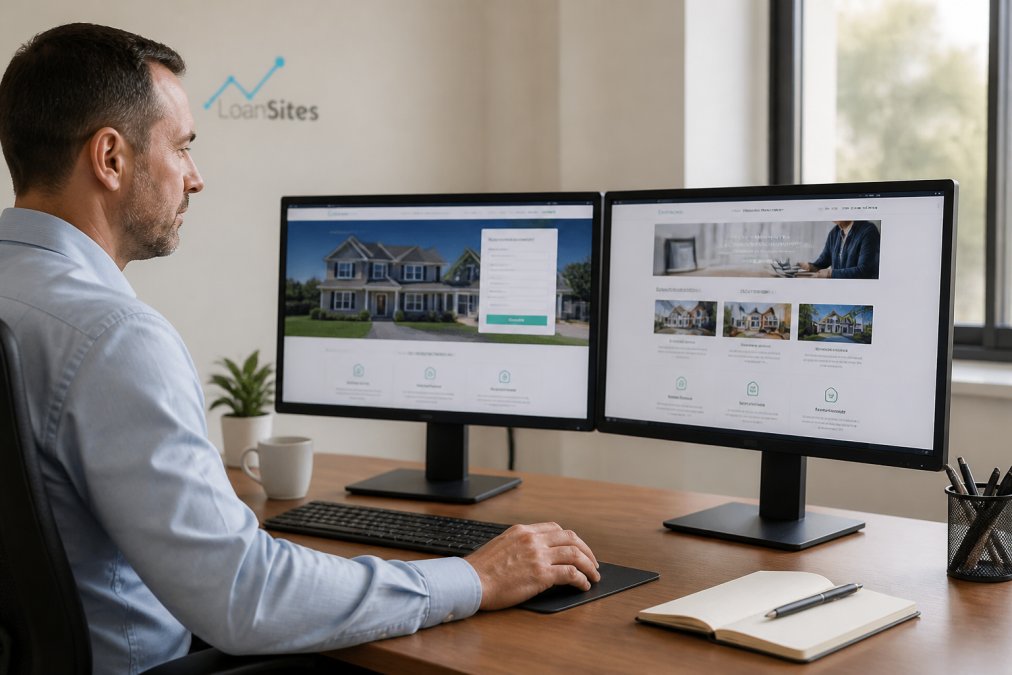
Comparison Table: Top Mortgage Website Design Solutions
| Solution | Best For | Starting Price | Lead Generation Focus | Mobile Optimized | ADA Compliance |
|---|---|---|---|---|---|
| LoanSites | Custom sites with unlimited support | See pricing page | Yes, built-in optimization | Yes, mobile-first | Yes, included |
| AgentFire | Branding-focused professionals | $149/month | Yes, lead capture tools | Yes | Not specified |
| Placester | Budget-conscious brokers | $59/month | Basic tools | Yes | Not specified |
| Lenderd | Custom professional builds | $2,500+ | Yes, mortgage-specific | Yes | Not specified |
| Roar Solutions | Lead generation focus | Contact for pricing | Yes, primary focus | Yes | Not specified |
| Wix | DIY builders | $12.99/month | Limited | Yes | Manual setup required |
| Squarespace | Design-focused professionals | $16/month | Limited | Yes | Manual setup required |
LoanSites stands out because it combines the speed of template builders (10 business days) with the customization and compliance focus of premium agencies. You get unlimited ongoing support and unlimited customization, meaning your site evolves with your business, not locked into a static template.
How to Choose the Right Mortgage Website Design Service for Your Business
Start by answering three questions.
Question 1: How fast do you need to launch? If you need a site live in under 3 weeks, template-based or expedited custom builds are your only options. If you can wait 6-8 weeks, you have more agency flexibility and customization depth.
Frequently Asked Questions
What features are essential for a mortgage website to generate leads?
High-converting mortgage websites need clear call-to-action buttons, mobile-responsive design, trust signals (testimonials, credentials), a mortgage calculator, and quick lead capture forms. Lead conversion rates for optimized mortgage websites reach 5-12%, compared to 1% for standard template sites. Integration with CRM systems and automated follow-up tools ensures no lead falls through the cracks once captured.
Why is ADA compliance important for mortgage websites?
ADA compliance protects your business from legal exposure while ensuring accessibility for all visitors, including those with disabilities. Mortgage websites must meet WCAG 2.1 AA standards, covering elements like alt text for images, keyboard navigation, color contrast, and screen reader compatibility. Non-compliant sites face lawsuits and damage to brand credibility. Professional mortgage website design services build ADA compliance into the foundation rather than retrofitting it later.
How long does it take to build a professional mortgage website?
Custom mortgage websites typically take 4-8 weeks when built by professional agencies, while quick-launch template solutions can go live in 1-2 weeks. Some specialized providers deliver custom sites within 10 business days by streamlining discovery and using pre-built mortgage-specific components. Timeline depends on customization level, content readiness, and integration complexity with your CRM or point-of-sale system.
Are DIY website builders sufficient for mortgage professionals, or do I need a professional service?
DIY builders ($100-$500 annually) offer affordability and control but require significant time investment and lack mortgage-specific optimization. They typically underperform on lead conversion and SEO. Professional mortgage website design services provide industry expertise, compliance assurance, and conversion optimization that DIY platforms cannot match. For loan officers serious about lead generation, professional design delivers better ROI despite higher upfront investment.
What should I look for when comparing mortgage website design services?
Evaluate services on: lead conversion optimization, mobile responsiveness, ADA compliance certification, CRM integration capabilities, SEO package quality, timeline to launch, ongoing support structure, and customization flexibility. Ask for case studies showing traffic and lead increases from past clients. Verify whether the service includes unlimited customization and ongoing support, or if changes incur additional fees. Compare total cost of ownership, not just initial price.


